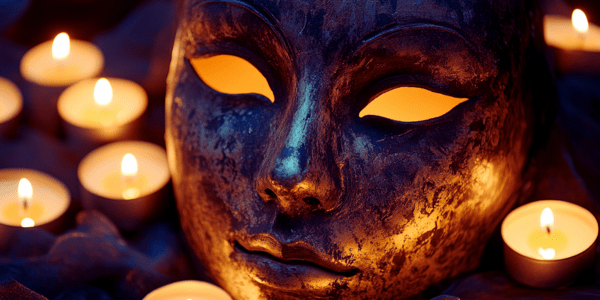
Autumn is upon us, my favourite season. I do love all the season, autumn though, is just so alluring to my introvert leaning personality – the delicious withdrawal into the self and the cosiness and comfort of soft candlelight, snug sofas bedecked with blankets, stews, soups…you get the picture!
I do enjoy a bright autumn day, the kind with crisp air, where low sunlight catches at the oranges and reds of the leaves in a kaleidoscope of colour, that beautiful display of the changing seasons, gilded with a touch of nostalgia and a hint of melancholy. But I also love the other kind of autumn day, the ones that start all dark and stormy, where the night gives way to grey skies blanketed in clouds that hang thick and heavy; where the wind drives the rain into the windowpanes and tears through the boughs of trees, sending those fiery leaves into a frenzy.
Just as the spring carries the bite of winter on it’s breath mingled with the hint of summers warming touch, so too is the autumn a season of duality, but one that carries us into the dark half of the year, and for us witches, that means Samhain is almost here.
I’m one of those witches that enjoys all the fun of Halloween (indeed neighbourhood kids can expect a suitably decorated garden and sweet treats at the door) and the sacredness of Samhain. That balance always reminds me of the Ghede family of lwa in Vodou, the sacredness of life and death but with frivolity that can and does sometimes border on the obscene.
Anyway, whilst planning my Halloween and Samhain activities, I got thinking about masks and their use in ritual, magic and witchcraft today and in times past. I think it is one of those oft forgotten aspects of witchcraft, even as we still make use of them.
And as Halloween is almost upon us, let’s start our exploration with that increasingly secular holiday. As we know (partly because it’s regurgitated every year), Halloween has a Celtic beginning, stemming from Samhain. The costume wearing that kids and adults like to do as part of modern celebrations began as a way of either scaring off the spirits that were said to be abroad at this time of year, or as camouflage to blend in with them and remain undetected. It’s also worth considering that the costumes might also allow us to face our fears and confront the things that scare us, including our own mortality.
But let’s not also forget mischievous night, which depending where you live, might be the night before Halloween or Halloween night itself. As the name suggests, it is a time for harmless jokes and pranks, and for such activities, the masks and costumes of the holiday also conveniently hide the identities of those spooky pranksters.
All great fun and games I’m sure we can agree, but masking also had spiritual and magical meaning in practice.
While visiting York, my husband and I went to Yorkshire museum (not to be confused with York Castle museum). They have fantastic natural history displays, but I was particularly interested in their Star Carr exhibit (I’m currently in the early research stage for another book project).
Star Carr is the name of a Mesolithic site believed to date from around 9000 BC, and it has provided archaeologists insight into the lives and perhaps religious and spiritual beliefs of early humans, at least in that part of the world. For me, one of the best aspects of the display are the red deer (and some roe deer) headdresses.
Such artefacts do not give definitive answers, but instead must be interpreted, and many believe the headdresses held more than just practical importance. It has been suggested that the headdresses formed part of a ritual dress of the spiritual leaders of those Mesolithic peoples, for whom deer were an integral part of their survival. Whether they were worn to embody the spirit of the animal or connect with the spiritual realm, I guess we will never know. I suspect there is truth in both, for the natural world and the spiritual world are but two sides of the same coin.
Masquerade is perhaps most associated with Venice carnival, and while not magical as such, it does deserve some mention here if only because magic, ritual and witchcraft are human endeavours. Traditionally, the wearing of masks at such events, whilst being fun, also allowed people of different social classes to mingle and mix in ways that would have been frowned upon in normal day to day life. As such, the masks offered a degree of anonymity giving the wearer freedom to behave and act in ways that transgressed social and political norms. In this we can draw parallels with how magic and witchcraft has been viewed across time and place.
We might see correlation with all of the above acts in ritual, witchcraft and magic today. Masks allow the individual to step out of their mundane worlds and enter the world of spirit and trance. They build our connection with the land where we live and the spirits and deities we work with and honour in our crafts. They allow us to traverse the realms, to become more than we are or to become non-human, to confront fears and step into the world of magic where a simple mask becomes so much more!
So if you are looking for something extra for your Samhain magic and rituals, consider making and wearing a mask. However you celebrate the dark half of the year, have a blessed one!
 Emma Kathryn Wild Witchcraft
Leave a comment